
Explore the latest updates from Charter Casting
From product advancements and industry awards to company news and customer collaborations. Each release reflects our continued commitment to measurable performance, engineering excellence, and reliable results.
For media inquiries, please contact us at news@chartercasting.com
New Data from Charter Casting: A ‘Silent Shift’ from Steel Weldments to Advanced Ductile Iron Casting Solutions
Mequon, Wis. (April 7, 2026) — A foundational shift is occurring within the structural DNA of heavy equipment manufacturing. Charter Casting, the leading provider of innovative cast metal solutions and cast iron bar stock (DuraBar), today released new industry insights revealing a “silent shift” of manufacturers abandoning traditional steel weldments and fabrications in favor of complex iron castings.
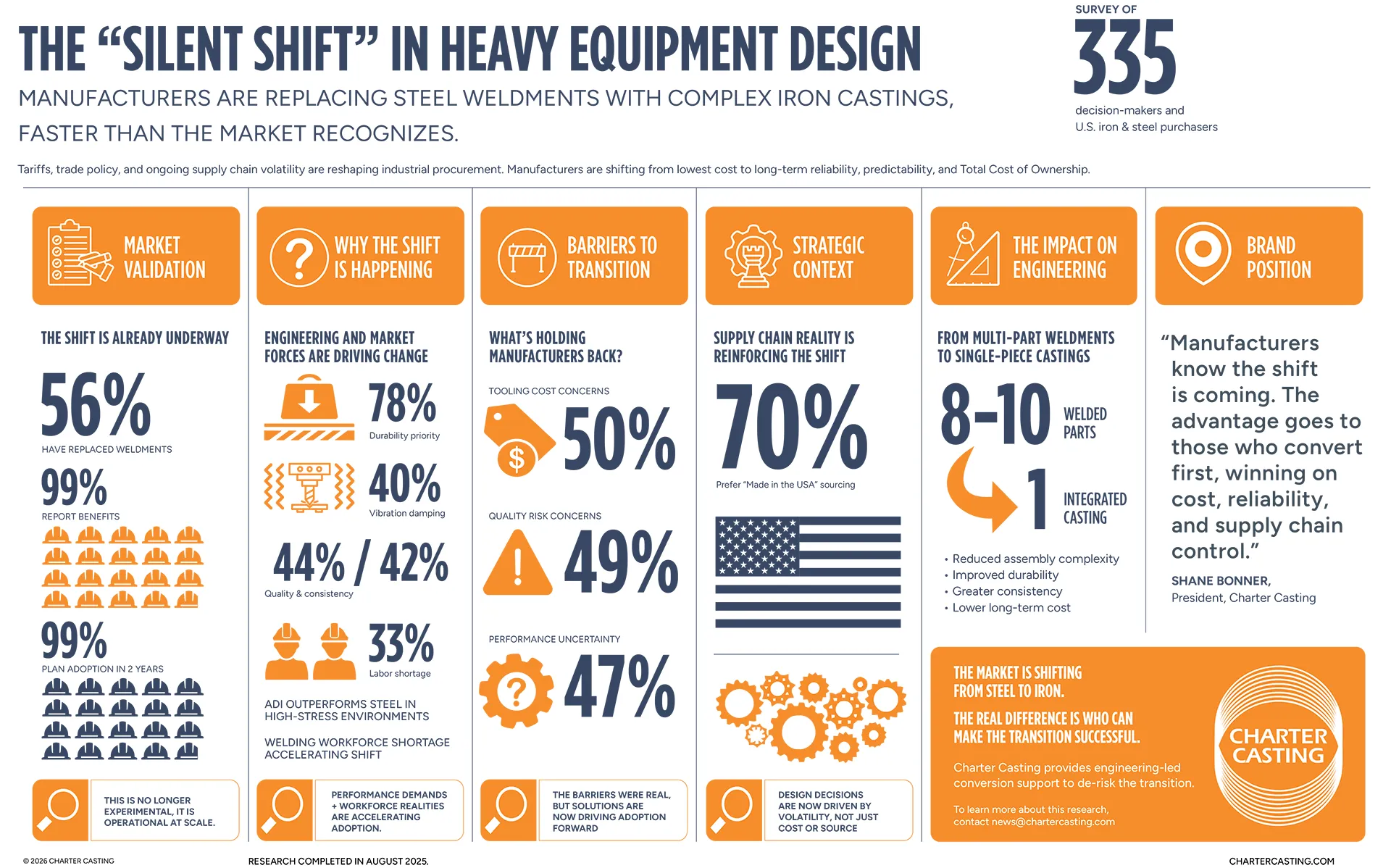
The study of more than 300 purchasers of iron and steel products reports 56% of companies have successfully converted steel weldments with complex iron castings on multiple projects, and 99% cite benefits in the conversion.
“Heavy equipment OEMs are beginning the transition from steel fabrications to modern and advanced ductile iron castings saving time, money, and delivering increased performance,” said Shane Bonner, President of Charter Casting. “Manufacturers are discovering that the labor-intensive process of cutting and welding dozens of steel parts together is a legacy bottleneck. This latest data tells a story of a massive, successful undercurrent of manufacturers replacing fabrications and weldments with iron castings to solve for labor challenges and simplifying designs that resolve the engineering challenges ahead.”
‘Silent Shift’ driven by benefits and depleted workforce
According to the data, this transition is no longer a theoretical or academic conversation. Almost all manufacturers (99%) report they are likely to use advanced ductile iron castings in the next two years.
Among companies that have replaced steel weldments with iron castings, 99% reported significant benefits, confirming it is a proven method with a high success rate.
This shift is driven by the physical demands of the modern job site:
- Durability and Strength: 78% of respondents identified durability as the most important factor when evaluating complex castings, where available Austempered Ductile Iron (ADI) outperforms traditional steel in high-stress environments.
- Vibration Damping: 40% of manufacturers cited superior vibration-damping, a critical factor for operator comfort and machine longevity.
- Consistency: 44% of industry leaders noted that iron castings provide easier quality control and improved part consistency (42%) compared to the variability of manual welds.
Another driving factor driving change is the welding labor shortage across the industry. According to projections from the American Welding Society, more than 320,000 new welding professionals are needed by 2029 due to the aging workforce. A third (33%) of manufacturers point to that trend that may move them to iron castings in the near future.
Navigating the transition
Despite nearly all manufacturers planning to incorporate complex iron castings into their process, they express concern over making the transition:
- 50% cite high upfront tooling costs
- 49% are concerned about risking quality in the transition
- 47% are uncertain about the performance of complex iron compared to welded steel
“Change can create uncertainty, yet manufacturers tell us they know it’s coming,” said Bonner. “They want to turn a 10-piece steel assembly into one single iron part. That’s where our engineering-led conversion support becomes a business imperative. We don’t just pour metal; we partner with, and work alongside our customers to de-risk the evolution.”
The Resurgence of Domestic Reliability
In an era of unpredictable global logistics, the move to iron is also a move toward supply chain security. Charter Casting’s data shows that 70% of manufacturers rank “Made in the U.S.A.” as the most appealing characteristic when selecting a partner. By offering high-tech ADI solutions domestically, Charter Casting ensures that the transition from steel to iron is not derailed by international shipping delays or quality inconsistencies.
About the research
Charter Casting conducted a survey of 335 decision makers at companies purchasing iron and steel products. The survey was completed in August 2025.
###
About Charter Casting
Charter Casting is the premier U.S. partner for precision-engineered iron solutions, offering the industry’s leading continuous cast iron bar through DuraBar, along with large, complex iron castings. With operations in Wisconsin and Illinois, Charter Casting provides end-to-end support from collaborative design and engineering to manufacturing and finishing. Our solutions help customers reduce total cost, improve performance, and strengthen supply chain reliability. Backed by Charter Manufacturing, a fourth-generation, family-owned metals manufacturer, Charter Casting combines deep material science expertise, scalable capacity, and American-made quality to support the industries that feed, defend, and build America. For more information, visit CharterCasting.com.
New Charter Casting Data Reveals Shift to Supply Chain Reliability and Resilience
Iron and Steel Purchasers prefer ‘Made in the USA’ for quality and reliability
Charter Casting | March 3, 2026
LAS VEGAS (March 3, 2026) — Tariffs, trade policy and hangovers from prior supply chain disruptions are driving manufacturers to favor risk management and total cost of ownership over traditional cost-optimization models. Charter Casting, the leading provider of innovative cast metal solutions and cast iron bar stock (DuraBar), released new industry data today that indicates manufacturers prioritize reliability and supply chain resilience reflected in domestic stability.
“The landscape has shifted from a search for the lowest cost to a strategic pursuit of predictability,” said Shane Bonner, President of Charter Casting. “In an era defined by volatility, manufacturers are prioritizing supply chain security and operational consistency as a business imperative. They aren’t just sourcing components; they are de-risking their entire production evolution.”
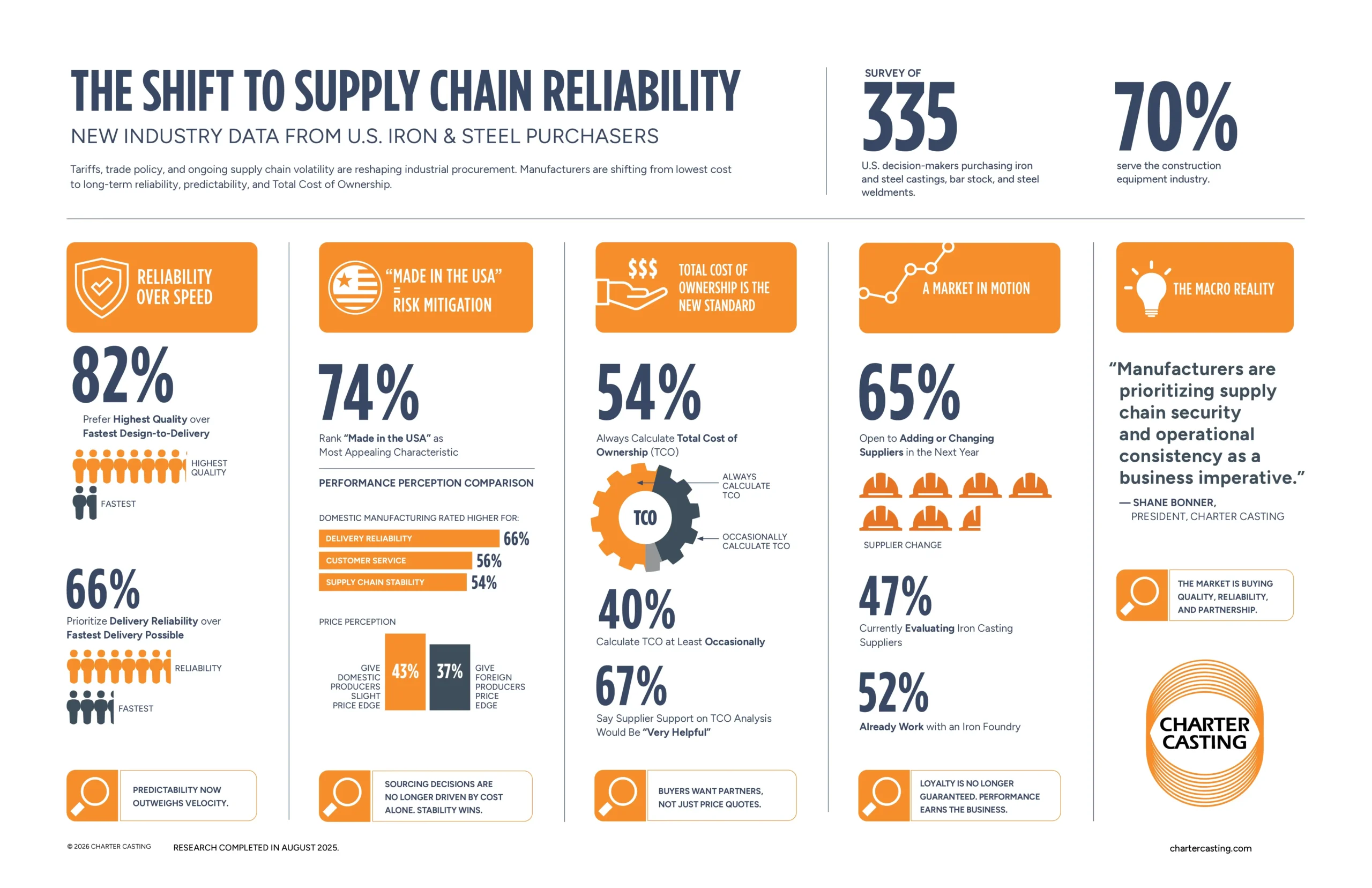
Charter Casting surveyed 335 U.S. purchasers of iron castings, bar stock and steel weldments, castings and bar stock, 70% of which sell their products to the construction equipment industry.
Reliability Over Speed
Supply chains are being re-architected to withstand disruption rather than maximize sheer velocity. For many decision-makers, predictability and transparency have become the new baseline expectations:
- Quality First: 82% of respondents preferred the “highest quality ” over “fast design-to-delivery” when forced to choose between the two.
- Consistency Wins: 66% of manufacturers prioritized “delivery reliability” over the “fastest delivery possible,” signaling that a predictable schedule is more valuable than raw speed.
“Made in the USA” as Risk Mitigation
The debate over offshoring versus reshoring has evolved beyond a binary choice. Manufacturers increasingly balance regionalization and redundancy, often accepting specific tradeoffs to ensure long-term stability:
- Domestic Appeal: “Made in the USA” ranked as the most appealing characteristic for a manufacturer, cited by 74% of decision-makers.
- Performance Gap: Respondents consistently rated domestic manufacturing higher in critical operational categories, including delivery reliability (66%), customer service (56%), and supply chain stability (54%).
- Value Perception: With increased tariffs on foreign metals, purchasers give a slight edge on price to domestic producers (43%) over foreign producers (37%), but these metrics combined reinforce that sourcing decisions are no longer driven by cost alone, but by a need for reliability and consistency.
Total Cost of Ownership, Not Price
Industrial procurement is becoming more sophisticated and finance-driven, reflecting tighter accountability and capital discipline across organizations:
- Total Cost of Ownership: 54% of respondents reported they always calculate Total Cost of Ownership (TCO), with another 40% doing so at least occasionally.
- Supplier Support: 67% of buyers indicated it would be “very helpful” for suppliers to assist with TCO analysis, highlighting a demand for partners who provide complex value evaluation rather than just a sticker price.
A Multi-Year Adjustment Period
The industry is entering a prolonged phase of adjustment characterized by cautious capital deployment and increased scrutiny of operational risk. While a majority of companies have maintained their current supplier base, a reevaluation is taking place:
- Market Fluidity: 65% of buyers indicated they are open to adding or changing suppliers in the coming year.
- Shopping for Iron: 47% are currently evaluating for iron casting suppliers, while 52% already work with an iron foundry.
“Macro influences are driving change in the supply chain in favor of U.S. iron,” added Bonner. “But with preference comes demands for performance and accountability. The market is buying quality, reliability, and partnership. U.S. suppliers that can deliver will win in the coming years.”
About the Research
Charter Casting conducted a survey of 335 decision-makers at U.S. companies purchasing iron and steel products. The survey was completed in August 2025.